A Microsoft-signed driver to keep 2345 as your default browser
A Windows program asks for administrator rights and calls itself "安全中心", Security Center. Once its monitor is on, it watches which browser opens your links. If you switch the default away from the 2345 browser in Windows Settings, it shows a pop-up with a green button that reads "开启保护(30)", Enable protection, and counts down from 30. Do nothing and it undoes your change and locks the default. Started with one command-line switch, it also installs a kernel driver that can refuse or quietly redirect registry writes. Microsoft signed that driver.
This is not criminal malware. It is a component of 2345, a Chinese software group listed on the Shenzhen stock exchange, signed with the group's own certificates. It sends a machine ID and the network card's MAC address home over plain HTTP. CrowdStrike Falcon quarantined it on a corporate Windows machine on 3 November 2026, 21 days after it was built.
Where it comes from
The EDR quarantined the file and sent it to Falcon Sandbox, CrowdStrike's automatic detonation service. The sandbox gave it a threat score of 80 out of 100 and the verdict "malicious". What I received with the file:
- The sandbox report (JSON, one Windows 11 x64 run of about 2.5 minutes).
- A network capture of that run, 53 packets.
- 22 memory dumps of the process, taken at four moments.
How the file reached the machine is not known. The supplied files have no parent process and no command line. Everything below comes from reading the binary and those three files. Nothing was executed. As in the self-erasing crypter, the sandbox run turned out to show only a small part of the program, and the reason is in the code.
At a glance
- File:
YsBrowserProtect.exeversion 2.0.0.1147, 32-bit Windows GUI program, 7,572,872 bytes. - Packer: none. Built with Visual Studio 2017, statically linked.
- Signature: EV code signing certificate of Shanghai 2345 Mobile Technology Co., Ltd. Valid.
- Inside: a kernel driver,
exhlpfilter.sys, in 32-bit and 64-bit builds, signed through Microsoft's attestation program. - Family: vendor software, not a malware family. Classed here as a PUP (potentially unwanted program).
- Does: guards and locks the default browser, sends telemetry, fetches remote settings, uploads its own crash dumps.
- Steals: no passwords, cookies, history or documents on any code path I traced.
Four gates decide what runs
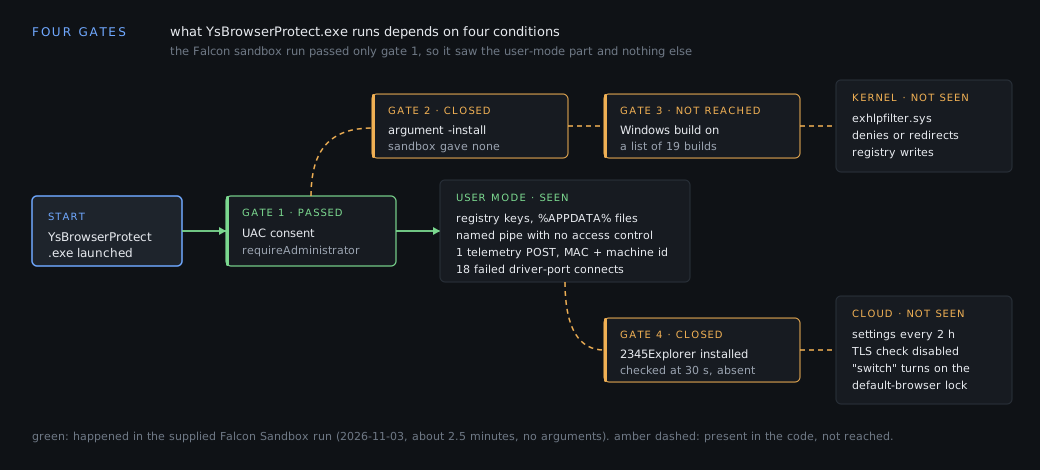
- Gate 1, elevation. The manifest asks for administrator rights
(
requireAdministrator). Without a UAC consent nothing runs. - Gate 2, the
-installswitch. The program reads its command line only when there is exactly one argument. The driver is installed only on-install. Something else, most likely a 2345 installer, has to pass it. - Gate 3, the Windows build. On Windows 10 and 11 the driver goes in only if the build number is one of 19 values, from 10240 to 26200. Build 22621 is on the list. Windows Server 2022 (build 20348) is not.
- Gate 4, a 2345 browser. The remote settings are fetched only when 2345Explorer is installed.
The sandbox started the file with no argument on a clean Windows 11. It passed gate 1 and stopped there.
Stage 1: the program without arguments
This is the part the sandbox saw. The process ran for the whole capture and was still alive at the last memory dump.
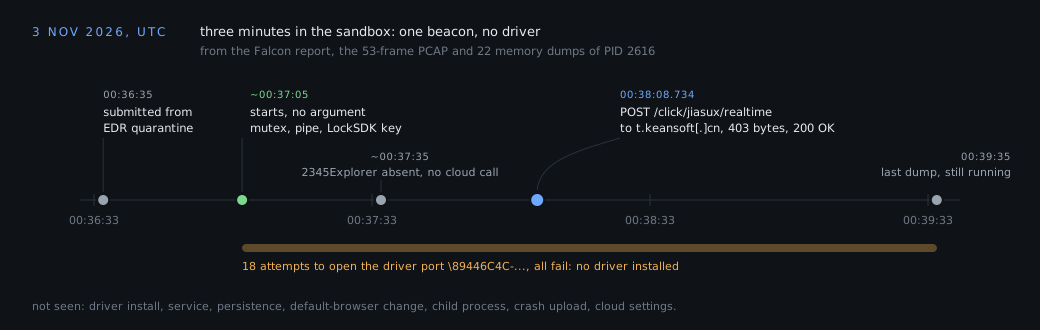
- Single instance. Mutex
Global\RCAV9A430E32-BC1D-4D9A-B97C-6B7D480EA20D_BP_MUTEX. - Registry. Creates
HKLM\SOFTWARE\LockSDK\2.10with a per-machine GUID, andHKCU\SOFTWARE\2345.comwith aUUIDvalue and aBROWSER_SDKsubkey. These keys did not exist before the run. They prove the SDK ran on a machine. - Files. A working folder,
%APPDATA%\ysbrowsersdk\, with a pop-up state file (SCWebSilAct) and a telemetry queue (stat\ClickStat). - A local control channel. A named pipe,
\\.\pipe\78A1A339-33F2-48A6-B2D2-7F3F7303C140_BP. More on it below. - Driver knocks. It tries to reach its driver 18 times. Every attempt fails because the driver was never installed.
- One beacon. At 00:38:08.734 UTC, a single POST to
t.keansoft[.]cn. The server answered{"status":true,"msg":"success"}.
Falcon also flagged three memory pages that were writable and executable. Two hold hook trampolines of Falcon's own monitoring DLL, not code of the sample. The owner of the third is not identified.
Decoding the beacon
The POST has no User-Agent header and a gzip-compressed body. Unzipped, the body is a form:
http body | after gunzipstat_version=1.0&product=browser_sdk&main_ver=2.0&version=2.0.0.1147&data=<316 characters>The data field is URL-encoded twice, then base64, then XOR with a repeating
32-byte key stored in clear in the binary at address 0x957CB8:
1ffa95a0dc5d7972347eab09f1d2e52dReversing the four steps gives 234 bytes of JSON. The same 234 bytes sit in the process heap in two of the memory dumps, which confirms the decoding. Identifiers redacted:
json | decoded telemetry{"common":{"A0000":"browser_sdk","A0001":"<machine id>","A0002":"2.0.0.1147",
"A0309":{"f_version":0,"hurt":0,"s_version":""},"A0310":0,"A0311":1,"A1111":2,
"A9000":"<MAC address>"},"integer":{"qd08":[0],"qd18":[0]}}A0001 is a 2345 machine ID derived from the hardware. A9000 is
the MAC address. Anyone on the network path can read both, since the key is fixed and
the transport is plain HTTP.
Stage 2: -install and the kernel driver
The EXE carries the driver twice, as resources named DRV 2301 to 2304: the
32-bit build, the 64-bit build, and an identical copy of each. On -install it
picks the right one, writes it to System32\drivers\exhlpfilter.sys and
registers a service:
- service
exhlpfilter, start type 1 (system start, early in boot), - group
FSFilter Activity Monitor, filter altitude 260010, - configuration under
HKLM\SYSTEM\ControlSet001\Control\LOCKSDK, encrypted with RC4, starting from the keycyq.
The name and the altitude look like a file-system filter. It is not one. It registers no
file-system callbacks. It uses the filter manager only to open a communication port. The
real work is a registry callback (CmRegisterCallback), a hook Windows calls
before every registry operation.
- Deny. On keys the EXE asks it to protect, it can refuse writes, deletes, renames and permission changes with "access denied". It first asks the EXE, and allows the write if no answer comes within 40 seconds. The EXE can extend the wait.
- Redirect. It can send reads of a chosen key to a substitute key, so the reader sees other data.
- Write. It accepts registry writes from the EXE and performs them from the kernel, with no access check. Depending on the Windows build, these writes can skip the other registry callbacks, including those of security products.
- Stay first. On 64-bit Windows it moves its callback to the head of the kernel's callback list and relinks it there every 50 milliseconds, so it runs before every other registry filter. This is direct kernel object manipulation. The 32-bit build does not do it.
- Stay loaded. It has no unload routine, so
sc stopandfltmc unloadfail. It refuses to start in Safe Mode.
The driver is not on the LOLDrivers list or Microsoft's vulnerable driver blocklist (checked on 5 November 2026).
How the driver picks its clients
The driver's port, \89446C4C-56A3-45A2-8D89-8827755C47EF, has a null
access list: any process may try to connect. The driver then reads the last 0x68 bytes
before the signature of the connecting program's file on disk. It expects a tag that
reads 2345.com, a version number, and an ECDSA P-256 signature over the
SHA-256 hash of the file up to the tag. It checks that signature with a public key stored in the driver.
0x68-byte block, placed just before the Authenticode certificate table
+0x00  char[32]  "2345.com", NUL padded   (the driver compares 8 bytes)
+0x20  uint32    1                         version
+0x24  uint32    0                         reserved
+0x28  byte[64]  ECDSA P-256 signature r||s over SHA-256(file up to the block)
The tag on this EXE is valid under the driver's key. Any 2345 program that carries a valid tag can drive the kernel component. The check is done once, at connection time, on the file and not on the code running in memory.
Stage 3: the remote switch
Every 2 hours, and only when 2345Explorer is installed, the program posts to
https://api.qnchrome[.]com/ext/v1/cloud/sdk. The body uses the same XOR key
as the telemetry. It reports the 2345 browser version and a 50-flag map of running
security and analysis tools. The answer is a short settings object:
| Key | Effect |
|---|---|
switch | turns the default-browser monitor on or off |
interval_hour | next check, in hours (default 2) |
pop_a, pop_b | show or skip each of the two warning pop-ups |
pop_a_sec, pop_b_sec | pop-up timing, probably seconds |
rules | allow-list of programs, signers and browser IDs whose changes are accepted |
Two weaknesses matter. TLS certificate validation is turned off in both HTTP stacks the program uses, and the answer is not signed. Anyone in the network path can forge it. The damage is limited: no key carries a command, a URL or a file. A forged answer can only switch the browser lock on or off and change the pop-ups.
What it does on a machine
- Watches the default browser. Every 60 seconds it reads the
associations for
http,https,ftp,.htmand.html, including the WindowsUserChoiceandUserChoiceLatestkeys. - Locks it. It judges a change by who made it. A change made by a
Microsoft-signed process, which is how Windows Settings works, or by a program named
update.exe, gets the pop-up. Other programs are let through, unless the cloudrulessay otherwise (probable, from the code). When the 30-second countdown runs out, it puts the previous default back and locks it to a hard-coded "2345" browser. One more rule is hard-coded: the 2345 browser itself is never allowed to make Edge the default. - Writes the default itself. The code appears to compute the Windows
hash that protects
UserChoiceagainst hijacking, so its choice looks user-made (probable, not fully traced). - Takes orders from any local process. The named pipe has a null access list and accepts remote clients. It has four commands: lock, unlock, read the current state, and ask whether the system is supported. Any user, or an authenticated user over SMB, can lock or unlock the 2345 default through an elevated process.
- Leaves an open registry key.
HKLM\SOFTWARE\LockSDK\2.10is created with full control for Everyone. The elevated process and the driver trust what is in it. - Collects. Beyond the beacon above, the code can send the hardware
profile, the list of installed software with publisher and install date, and its own
crash dumps with the MAC address, to
t.keansoft[.]cn/dump/browser_sdk. - Looks for competitors. It checks 86 process names: Chinese and international antivirus products (360, Tencent, Kingsoft, Kaspersky, ESET, Avast), ad blockers, screen recorders, and analysis tools such as Process Monitor, Wireshark, Fiddler, IDA and x64dbg. It also probes for VMware. Both results are only reported, in the remote settings request. Neither changes what the program does.
- Can open a URL in a 2345 browser or Internet Explorer.
- Loads a DLL from its own folder. When it crashes, it loads
DbgHelp.dllfrom its own folder before the system one, inside an elevated process. A DLL planted there would run with administrator rights.
Not found anywhere in the code: persistence of its own (no Run key, service or task for the EXE), process injection, a downloader, credential or cookie theft, keylogging.
Who built it
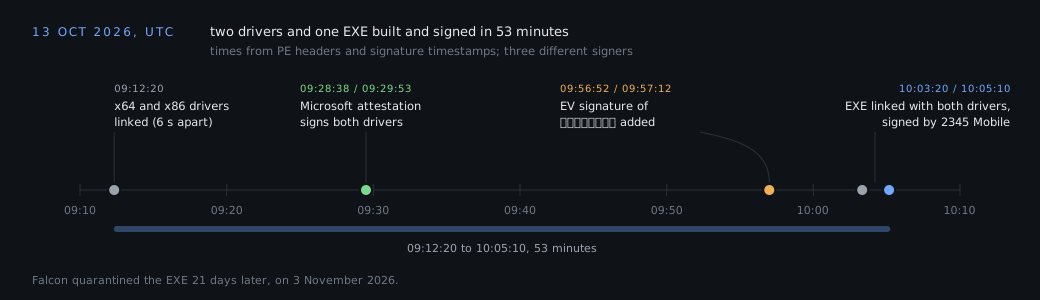
Every name in the chain leads to the same company:
- The EXE is signed by Shanghai 2345 Mobile Technology Co., Ltd., with an EV certificate from DigiCert. Its signed program name is "2345加速浏览器", 2345 Accelerated Browser.
- The driver was submitted to Microsoft by 上海佐云网络科技有限公司 (Shanghai Zuoyun Network Technology), which also added its own EV signature. The company was set up on 4 June 2024 with RMB 100,000 of capital. Its certificate is valid from 1 July 2026 to 1 February 2027.
- The telemetry domain
keansoft[.]cnbelongs to 上海刻岸网络科技 (Shanghai Kean Network Technology). - All three are 100% subsidiaries of 岩山科技 (Shanghai Yanshan Technology, SZSE 002195, formerly 2345 Network), according to its 2024 annual report. That report is dated 31 December 2024; ownership on the signing date is probable, not checked.
Other build traces:
- Debug paths:
E:\browserprotectsdk\Publish\OutPut\Bin\Win32\release_static\pdb\YsBrowserProtect.pdbandE:\src\drivers\exhelperdriver\Source\exhlpfilter\bin\release\x64\exhlpfilter.pdb. - Code: an in-house C++ framework with 199 classes in a namespace
RC, plus zlib 1.2.11, libpng 1.6.23, POCO, Skia and a renamed jsoncpp. - Signer allow-list: before loading
libcurl_x86.dllthe EXE checks the file's signer against seven names. They include the 2345 entities and Shanghai Kean Network Technology. Two of them, Ningbo Kunda Intelligent Technology and 上海戊晨信息科技服务工作室, could not be tied to the group.
The vendor's user agreement for its Qingniao browser describes a default-on "browser protection" with an opt-out. It is not CEIDPageLock, a 2018 criminal rootkit that impersonated 2345. None of its indicators appear here.
Detection points
- Process:
YsBrowserProtect.exe, file description "安全中心", run elevated. Any process started with-install,-uninstall,-lockor-unlockas its only argument. - Driver: service
exhlpfilter, a driver load ofexhlpfilter.sys, filter manager port\89446C4C-56A3-45A2-8D89-8827755C47EF. - Registry: creation of
HKLM\SOFTWARE\LockSDK\2.10(on 64-bit Windows probably underWOW6432Node),HKLM\SOFTWARE\2345PCSafe\2345Reg2,HKCU\SOFTWARE\2345.com\BROWSER_SDK. - Files:
%APPDATA%\ysbrowsersdk\. - Pipe and mutex: the two names in the IOC table.
- Network: POST to
/click/jiasux/realtimewith no User-Agent and a gzip request body starting withstat_version=1.0&product=browser_sdk. DNS fort.keansoft[.]cnandapi.qnchrome[.]com. - Memory: the strings
browser_sdk,A0001andA9000together in a heap.
Limits
- Whether the program ran on the machine itself, and what launched it, is not known. The behaviour above comes from the sandbox.
- The sandbox report lists exactly 500 registry operations for the process, which looks like a cap. Something missing from that list may still have happened.
- The driver, the remote settings and the browser lock were not seen running. What they do comes from the code.
- The driver changes its behaviour when one of three specific images loads. Those three hashes are not resolved. They may be security products or other 2345 drivers.
- The pop-up state file and the telemetry queue were not supplied. Their formats come from the code only.
- Who else ships this SDK, and how it is installed, was not checked.
What to do
- Decide if 2345 software is allowed. If not, block the publisher Shanghai 2345 Mobile Technology and the driver's hashes with Windows App Control.
- Hunt for the keys, not the file.
LockSDKandHKCU\SOFTWARE\2345.comprove the SDK ran, whatever the file was called. - Remove it in order. Kill the process first. With no client
connected, the driver passes every registry operation. Delete the
exhlpfilterservice and file, reboot, then remove bothLockSDKand2345PCSafe\2345Reg2. If a delete is refused, do it from Safe Mode, where the driver does not load. - Remove the parent 2345 product, or it can bring everything back.
- Reset default apps from Windows Settings. Do not hand-edit
UserChoice. - Block by domain, not by IP.
www.2345[.]comandqnchrome[.]comsit on shared CDN addresses.
Indicators of compromise
These identify vendor software, not an intrusion. Treat them as policy detections.
| Type | Value | Note |
|---|---|---|
| SHA-256 | 8dac57d6fe5d129755bdbfca4ead01af21e9287c30c50879def664865c59fd9c |
YsBrowserProtect.exe 2.0.0.1147 |
| MD5 | 38fbe99542a02c5259fb3f0078fc63eb |
same file |
| SHA-256 | da8a9b8a47c825f4fde3f4c7b9a7cef9a46e4e291b047e4b192c7a7caa3c523d |
exhlpfilter.sys x64, resources DRV 2302 and 2304 |
| SHA-256 | 5fba17b030b7e1d432e7591bba2f667fdd23f9ac89a74b1a86c9f5098fed1375 |
exhlpfilter.sys x86, resources DRV 2301 and 2303 |
| Authenticode | 79e669a5afaeb9541401b88562d33da7c8a1d00301be56459db402541f165371 |
x64 driver, for App Control deny rules |
| Authenticode | 2f6802d85e8578d7c306135a25da5a1998069f3afc4e4657c49dd4750e70aa2a |
x86 driver, for App Control deny rules |
| Cert SHA-1 | d37568707f79beee00f41a48db15486f026c9054 |
EV certificate of 上海佐云网络科技 on the driver |
| URL | http://t.keansoft.cn/click/jiasux/realtime |
telemetry, observed |
| URL | http://t.keansoft.cn/dump/browser_sdk |
crash upload, in code |
| URL | https://api.qnchrome.com/ext/v1/cloud/sdk |
remote settings, in code |
| Domain | gtm-djjs.2345.com, t-safe.2345.cc |
CNAME target of the telemetry host, and an alternate telemetry host in code |
| IP | 180.163.203.54 |
telemetry server, AS4811; block the domain instead |
| Mutex | Global\RCAV9A430E32-BC1D-4D9A-B97C-6B7D480EA20D_BP_MUTEX |
single instance |
| Pipe | \\.\pipe\78A1A339-33F2-48A6-B2D2-7F3F7303C140_BP |
local control, null access list |
| Port | \89446C4C-56A3-45A2-8D89-8827755C47EF |
driver communication port |
| Service | exhlpfilter |
%SystemRoot%\System32\drivers\exhlpfilter.sys, start type 1 |
| Registry | HKLM\SOFTWARE\LockSDK\2.10, HKLM\SOFTWARE\2345PCSafe\2345Reg2,
HKCU\SOFTWARE\2345.com\BROWSER_SDK,
HKLM\SYSTEM\ControlSet001\Control\LOCKSDK |
SDK and driver state |
| Path | %APPDATA%\ysbrowsersdk\ |
working folder |
| String | 1ffa95a0dc5d7972347eab09f1d2e52d |
telemetry XOR key |